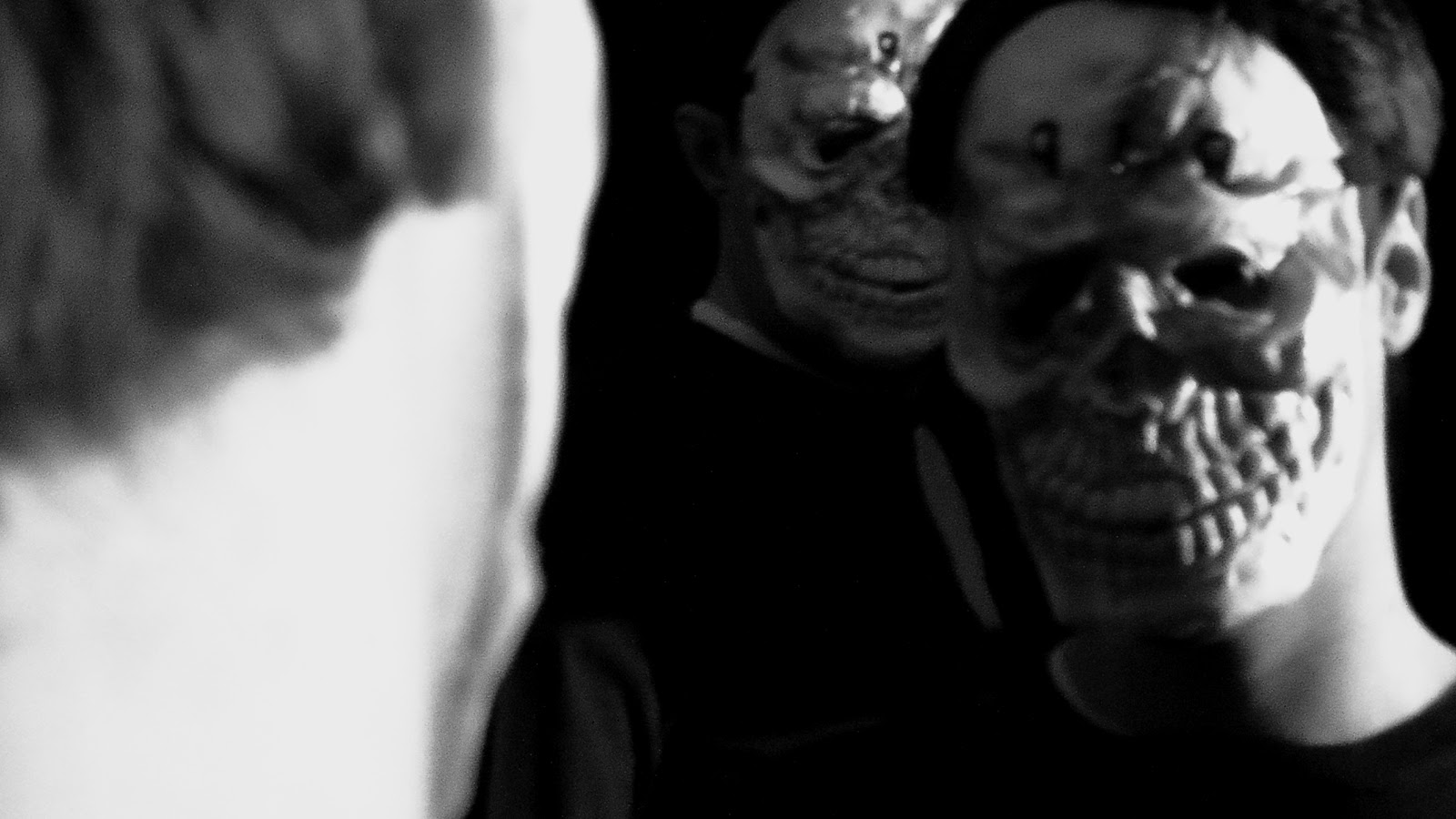
THE GHOST TIDE
curated by Monika Bobinska and Sarah Sparkes
Thames-Side Studios Gallery, Thames-Side Studios, Harrington Way, Warspite Road, Woolwich, SE18 5NR. www.thames-sidestudios.co.uk
EXHIBITION DATES 20 October – 3 November
GALLERY OPENING HOURS Thurs-Sun 12pm – 5pm
OPENING PARTY Friday 19 October 6pm - 8.30pm
Gen Doy performance 7.30pm
The Ghost Tide - coinciding with the festivals of Hallowe'en, All Souls and the Day of the Dead - takes as its starting point the perspective that ghosts exist as an idea, or as part of a belief system, across cultures, across national borders and throughout recorded history. Most languages contain words to describe the ghost, spirit or immaterial part of a deceased person. Often, these words - like the type of ghost they describe - have traversed borders and been assimilated across cultures.
The exhibition, situated next to the Thames Barrier in South-East London, evokes ghosts as a migratory tide, washed up along the shore of the Thames their historical baggage in tow. It also explores the presence of artists in this part of London, as a migratory tide of creative flotsam and jetsam which ebbs and flows as the city gentrifies and develops.
Featured works include sculpture, installation, film, sound, performance and wall based works. The exhibition will include installations and outdoor interventions, as well as public events.
The Ghost Tide features works by over 30 UK and international artists.
Artists featured: Andrea G Artz, Chris Boyd, Davies, Monaghan & Klein, Gen Doy, Sarah Doyle, Graham Dunning, Diane Eagles, Andrew Ekins, Charlie Fox, Katie Goodwin, Kio Griffith, Miyuki Kasahara, Calum F Kerr, Rob La Frenais, David Leapman, Liane Lang, Toby MacLennan, Laura Marker, Joanna McCormick, Josie McCoy, Jane Millar, Output Arts, Miroslav Pomichal, Brothers Quay, Anne Robinson, Edwin Rostron, Matt Rowe, Sarah Sparkes, Charlotte Squire, Sara Trillo, Yun Ting Tsai, Kate Walters, Patrick White, Heidi Wigmore, Neale Willis, Mary Yacoob, Neda Zarfsaz.
About the Curators: Monika Bobinska is the director of CANAL, which organizes exhibitions and art projects in a variety of settings. She is the founder of the North Devon Artist Residency.
Sarah Sparkes is an artist and curator. She leads the visual arts and creative research project GHost (initiated in 2008), curating an on-going programme of exhibitions, performances and inter-disciplinary seminars interrogating the idea of the ghost.
CURATORS' TALK Saturday 20 October 3pm – 4pm
DAY OF THE DEAD CLOSING PARTY Saturday 3 November 2pm – 7.30pm
Papel Picado Workshop 2pm – 5pm Make your own Day of the Dead 'cut - outs' with artist Sarah Doyle. Suitable for all ages, materials provided
Performances and Artist Led Walk 2pm – 5pm Charlie Fox, Calum F Kerr, Joanna Mccormick, in and around the gallery
Day Of The Dead Feast 5pm – 6pm Refreshments served
International Film Screening 6pm Screening of short films in the gallery: Chris Boyd, Liane Lang, Brothers Quay, Yun Ting Tsai and Neda Zarfsaz
For more information, contact us on l 0786 606 3663 | 07900 208 711 |
theghosttide@gmail.com
www.ghosthostings.co.uk | www.canalprojects.info
Showing posts with label GHost. Show all posts
Thursday, 13 September 2018
The Ghost Tide
Labels: ghost, film, art, haunting, host, video
CANAL Projects,
GHost,
Guest Host Ghost,
Monika Bobinska,
Sarah Sparkes,
Thames Barrier,
Thames-side Studios Gallery,
The Ghost Tide,
Woolwich
Sunday, 12 January 2014
Hostings 13 - GHost-dance III: time travelling mediums
February 17th 6.30 - 9.30
Central St. Martins College of Arts and Design, LVH E003
Granary Square London, Nr Kings Cross
London
N1C 4AA
GHost hosts an evening of presentations and performative presentations exploring the idea of ghosts as material transmutations in time.
GHost Hostings 13 is supported by the Centre for Performance, Central St Martins School of Arts
Hostings 13 image - Anne Robinson Is It You
PROGRAMME
Vicky Smith Haunting a medium through physical residue.
Jessica Worden Materialising the Body: Material Phenomena and Sartre's Theory of Viscosity.
Anne Robinson Is It You? Time travel and Physical Thinking.
Eleanor Bowen Drawing and Longing
I will talk about how imagery created directly onto film can deal with things that have been abandoned or are undervalued. Using clips from my recent film/ performance, 36 Frames Per Feet, I will illustrate how film, once inhabited, now presents only the trace of the absent body. I will discuss this in relation to Walter Benjamin’s meditation on the modern body in an age of animated machinery and his suggestion that the death of a technology releases the hopes which were embedded in it at its birth. Early cinema was proclaimed as ‘life itself’ (Doane, 2008). I will show how, by enlivening film with my own body and refusing to let film die, my research corresponds to the concerns of Ghosting with regard to themes of absence, presence, the politics of commodification and as a lamentation for what is lost.
Vicky Smith’s practice incorporates experimental animation and performance. Her work will be shown at The Tate Britain this Feb, 2014, and has recently been exhibited at: No. w.here, London (2013) Lo and Behold, London (2012/2013), 100 Feet touring (2013-14) Edinburgh Film Festival (2012), Melbourne Experimental Film Festival (2012). Recently published work includes: Full Body Film in Sequence (2013). She was Workshop Organiser at the LFMC , lectured in Film Studies at UWE, and is currently at UCA, teaching Digital Film and Screen Arts and researching into the aura and trace using films made without cameras.
Jessica Worden. Materialising the Body: Material Phenomena and Sartre's Theory of Viscosity (because slimy substances stick to the hands , and clothes, and because they stain) — Sartre, 1943.
Sartre describes the viscous in terms of its qualities, trying to create parameters around a state that is ‘always fleeing’. (Sartre, 1943) There is ample critique of Sartre's theory of viscosity (the slimy)— particularly the use of feminine metaphors to describe its negative attributes. By applying the properties of viscosity to the role of material phenomena in altering definition(s) of the female body, it is possible to underline the radical nature of these performances and potentially reclaim the viscous. Ectoplasms have been extensively cataloged and documented since the 1880's; the advent of their distinctly material ormations occurred simultaneously with the changing roles of women in society. Viscosity defies definition; it is my intention to suggest through visual and textual re-appropriation ways in which women utilised ectoplasmic manifestations to influence the definition their bodies and modes of (re)production by embracing viscosity.
I am a Dutch/American artist currently undertaking a practice-based PhD in Breathlessness in Performance in the Contemporary Performance department at Brunel University. I have been working with live art since 2005, having also run a live-arts platform from 2006-2008 in Rotterdam, NL. My practice is influenced by photography, but based in performance writing. I produce artist books, installations and performance pieces. My aim is to explore writing-as-performance and the interplay between the visual and the textual
Anne Robinson. Is It You? Time Travel and Physical Thinking
This paper focuses on the two-screen performative video work, Is It You? a ‘ghost dance’ with polyrhythmic patterns made in response to the spectral traces of physically ‘remembered’ songs (including Toots and the Maytalls’ Pressure Drop). Is It You? engages with the ‘frame’ as temporal marker, using slow shutter-speeds and high speed filming to capture the ‘same’ moments in time using different time bases. This is an unsettling experience of time deconstructed through cinematic devices which catches the spectator in a circuit of afterimages and pushes them into a strange, dissonant perceptual dimension, parallel to the temporal alterations in shamanic drumming. The experience of sound in the work is also immersive, pushing language to the threshold of recognisable auditory form. The talk draws on a body of practice-led research into temporality and philosophical perspectives from Merleau-Ponty, Deleuze and Gidal. Extracts from Is It You? (2012), Que Sera (2010) and Inside Out Blues (2013).
Anne Robinson’s practice encompasses painting, moving image and performance and is concerned with the perception and politics of time passing, recently working with the Commonist Gallery, ‘Winter Shuffle’, Supernormal, Psi19 and GHost IV following a PhD on temporality, film and painting. In summer 2013, she took part in the ‘DeTours’ residency inMarseilles, resulting in the performative song-film ‘Inside Out Blues’. She works with film as an artist and educator, currently senior lecturer in Film at LMU, curating the event One More Time there in 2011.
Eleanor Bowen. Drawing and Longing (performed text with slide projections)
My presentation for GHost is developed from material that was published in Performance Research, ‘On Choreography’ (Vol. 13: 2, 2008). It investigates the alchemical notion of parastasis as phenomenon of haunting that, rooted in the ancient desire to stop time by replicating or fixing the present, was eventually realised in the photograph. Such a haunting does not relate to the making of photographs, the spirit world of the darkroom, but reflects the unseen presence of the camera itself and its relationship as such to time travel. Incorporated into the presentation are readings of snaps from ancestral albums, found photos and pinhole images made in an underground archaeological site, not a burial but the archive of an archaeologist who was also my father.
Eleanor Bowen is a writer and visual artist, currently with a studio practice in London. She holds an MA in Visual Art and Theatre and a practice-based PhD from Wimbledon School of Art, in which she explored the relationship between early photographic practice and drawing. Publications include contributions to Performance Research, ‘Lexicon’ (11: 3, 2007) and ‘On Choreography’ (13: 2, 2008), http://process.arts.ac.uk/content/drawing-and-longing-proposal-drawing-paratext, ‘Between Laughter and Crying’, co-written chapter with Dr Laura Gonzalez for ‘Madness, Women and the Power of Art’, Oxford, Inter-Disciplinary Press (2014) which is to be developed as a co-performed text for ACTS RE-ACTS (March 2014, Wimbledon College of Arts).
Labels: ghost, film, art, haunting, host, video
Anne Robinson,
CSM,
Eleanor Bowen,
GHost,
GHost-dance,
GHost-dance 13,
Jessica Worden,
performance film,
Sarah Sparkes,
time-travel,
Vicky Smith
Thursday, 2 May 2013
Hostings 12 - GHost-dance II
GHost presents the second in a new series of Hostings – 'GHost-dance' – exploring the idea of ghosts as cultural and political movement.
21st May 6.30 - 9.30
please arrive at 6.00pm for a 6.30pm start
Central St Martins College of Arts and Design
Studio Theatre
Granary Square
London
N1C 4AA
(near Kings Cross over and underground stations)
please arrive at 6.00pm for a 6.30pm start
Central St Martins College of Arts and Design
Studio Theatre
Granary Square
London
N1C 4AA
(near Kings Cross over and underground stations)
With:
Gen Doy, Song for the Deaf and Blind
Mitsu Salmon, Skating
Christian Weaver, Trillando en el cajón: mediating positive and negative forces in the realm of the dead through music and dance
Michelle Hannah, BLACKCAT
Dr Mark James Hamilton, SaVAge SEAnce: An Invitation to Activate Your Ancestry.
and
Installation by Jennie Fagerstrom
Sell Tickets Online through Eventbrite
Gen Doy, Song for the Deaf and Blind
Song for the Deaf and Blind was
first performed in early 2013 at the Huguenot Cemetery in Wandsworth
Town, south London, where it was recorded for an installation. This
performance develops some key themes of Gen Doy’s work….the
attempt to bear witness to, and to remember, people subjected to
injustice and violence by forces of the state, the importance of
history and those marginalised by mainstream historical narratives,
the power of site-specific commemorative acts and the ways in which
the past returns not as nostalgia, but to come into collision with
the present.
Gen Doy was a lecturer and researcher
for many years at De Montfort University before taking early
retirement to develop her art practice. She lives in London, and has
two grown-up sons. Her works have been exhibited, installed, and
broadcast on radio.
Gen works with written and spoken
texts, field-recordings, still and moving images, and performance, to
construct narratives that are not linear, but suggestive and open to
creative interpretation by the listener/viewer. The voice has become
important in her work, as she exploits its sensual and seductive
potential, to bring to light and sound people and events hidden or
forgotten. The words of people from the past, and emotions from
barely smouldering embers, pass through the flesh of her body and
live again in her voiced breath. Her aim is to make poetic art with
“guts”.
http://www.gendoy.com
Christian Weaver, Trillando en el cajón: mediating
positive and negative forces in the realm of the dead through music
and dance.
In the 21st century Cuban
capital, Havana, and throughout much of the island, communities of
diverse and mixed origins dance with the ghosts of their ancestors on
a daily basis. The ceremony known variously as ‘cajón pa’ los
murtos’, ‘cajón espiritual’, ‘cajón pa’egun’, or simply
‘un cajón’ makes use of espiritist techniques, along with
sentimental, spiritual and ritual elements of various religions to
extract useful advice, guidance and cleansing from ancestor spirits.
The ‘cajón espiritual’ has its roots among Cuba’s marginalised
and disposed who sought reassurance and support from both their
direct ancestors and various international ancestor spirits who’s
repute or power made them attractive as guides. The tools they chose
were simply those at hand, and whose efficacy was already established
to them. Not the least of these being drumming (in this case on
wooden boxes, from where the ceremony derives its name, cajón),
singing and dancing, as participatory acts. Although the cajón
includes potent elements and symbols taken from a range of influences
(including Lukumí, and Native American), the principal elements are
derived from Catholic and Congo religious practices, and to a lesser,
but still important, extent, Kardecism. The process through which
these forces are meditated and usefulness extracted, is known as
trillando (from the Spanish verb trillar, to thresh).
Powerful religious and spiritual fragments are threshed together
within the ritually controlled environment of the cajón in order
that the beneficial can be separated from the unavoidable (and
balancing) negative. This paper examines the central role of music
and dance in the process of trillando, how social cohesion is
encouraged through participation in these activities, and the
relationship with the dead enacted in order that social usefulness is
extracted and exploited by the community.
As an initiated drummer, Christian
Weaver regularly performs ritual music for ceremonies in Havana. He
has researched the music and dance of Afro-Cuban religions, and the
vernacular music of Cuba’s urban poor, since 1994. He was awarded
his PhD in Ethnomuiscology in 2010.
http://www.latimbala.com/
Mitsu Salmon, Skating
I studied and performed the Butoh dance
form in Japan for three years. Butoh emerged after WW2 and sought to
embody ancestors, ghosts and darker aspects of the psyche. In this
piece I draw from Butoh's use of possession and exploration of the
unconscious.
http://www.latimbala.com/
Mitsu Salmon, Skating
I studied and performed the Butoh dance
form in Japan for three years. Butoh emerged after WW2 and sought to
embody ancestors, ghosts and darker aspects of the psyche. In this
piece I draw from Butoh's use of possession and exploration of the
unconscious.
'Skating' is a dance/ theatre piece
about embodying histories, searching for identity and failure.
The piece begins with looking for a
role model as a Japanese American young girl and being unable to find
one. Then while watching the Olympics with my grandparents, who are
from Japan, I discovered the Olympic ice skater Kristy Yamaguchi.
Afterwards I began ice-skating. Throughout the piece I speak of my
family's history, that of my grandmother growing up in Japan during
WW2 and my grandfather being Japanese in the USA army. My
grandfather was in the USA occupational forces in Japan and his
fellow soldiers were in internment camps during the war in the
states.
While imitating Kristy Yamaguchi
through movement, projected footage of the ice-skater herself is
intersected with film of the USA occupation of Japan.
I fall repeatedly, failing to achieve
an ideal Japanese American identity and also struggling to shed my
family histories. The dance is how my body holds the painful
histories of my ancestries - ghosts of war and assimilation.
'Skating' explores the
intersection of personal history to cultural history. The piece
begins with humour and story telling and builds to a dance where my
ancestors ghosts ate channeled and exorcised.
Mitsu Salmon is currently a MFA student
in performance at the School for the Art Institute in Chicago. She
creates original performance and visual works, which fuse multiple
disciplines and cultures. She was born in Los Angeles, California
and studied experimental theatre and painting at NYU. She has lived
and created work in India, England, Germany, Amsterdam, Japan and
Bali. She has presented at places such as Performance Space 122,
Dance Theatre Workshop, Highways Performance Space, Links Hall, the
Berlin Performance Art Festival and the London Performance Art
Festival.
Michelle Hannah, BLACKCAT
"There is a strong sense of
Romanticism in my practice, mainly in the roles which sound,
performance and expanded cinema has in tackling the themes of
metaphysics and science fiction. BLACKCAT is a performance of an
appropriated and fragmented version of Bowie’s Cat People by means
of a vocal processor. The starting point of this is from its esoteric
femininity to create BLACKCAT as a visual presentation of channeling
vocals and cosmic noise as form, presented as a dispersed engagement
between myself as ‘blind ‘ ethereal performer and you as a
viewer. I wear theatrical white blind contacts to erase my sight.
Blinded and struck for a moment, this ‘illuminated singer’ no
longer discerns the limits of the room. I become at once trapped in
the point of darkness and light."
Michelle Hannah is a Glasgow based
artist born in Alexandria, Scotland and a graduate from the Master of
Fine Art course at Glasgow School of Art. Selected
exhibitions/performances/screenings include NGCA, Modern Edinburgh
Film School, CGP London, Whitely Arts Festival, University of London,
Vetlanda Museum, Glasgow Project Rooms, Gi 2012, Dresden Film
Festival, CCA, Generator Projects, Embassy Gallery and is now the
curator of a performance and video based event under the theme and
title 'NITEFLIGHTS' which will appear throughout Glasgow.
The SaVAge K'Lub - Rosanna
Raymond – Sistar S’pacific, Emine, Jo Walsh, Dr Mark James
Hamilton: SaVAge SEAnce: An
Invitation to Activate Your Ancestry.
"Our
dead are woven into our souls
like
the hypnotic music of bone flutes:
we
can never escape them."
Albert
Wendt
This
SEAnce is a participatory presentation, inviting those gathered to
experience a core concept informing the SaVAge K'Lub's creativity:
even the long-dead are nearby. A performance will occur (a
word used in its widest and least defined sense). The deeds enacted
will aid those present to call upon potentials immanent in their
human being, in their genetic material. Ancestry will be addressed as
a vital force, a sustaining resource.
Albert
Refiti (Samoan visual arts scholar), writing of an earlier K'Lub
event in Canada, states that Raymond refuses to relegate ancestors to
a mythical past, and addresses them as available and present, located
within one’s body. Raymond, says Refiti, embraces the tensions of
tradition and contemporaneity prominent in—but not limited
to—cross-cultural artwork. The K'Lub site their presentation at the
intersection of polarised values, seeking relationship between
cosmopolitan and village-centric values, engaging with the spectral
phantom of sameness and the haunting substance of difference.
In
the SEAnce, the K'Lub will elaborate on Polynesian protocols of
meeting and invocation to invite attendees to establish a position
between the Earth Mother and the Sky Father. Through simple communal
movement and vocalisation, these elemental ancestors will be evoked.
Subsequent deeds will seek out connections to ancestral Mountains,
Rivers, Lands, Houses and Forebears. Here the collective may begin to
individuate. Multiple perspectives will be entertained.
For
some gathered, it is possible that a deep sense of ancestry may be
contacted. At the same time, it might be that the nostalgia,
Romanticism, and exotica are indulged. And what of lineages beyond
bloodlines? The cross-currents created by cultural adoption and
appropriation will be supported. The K'Lub does not guard against the
disruption of categories—authentic and original meets fictive and
faux. Mindful of the layered significance of the Ghost Dance proper,
the SEAnce will ask not whose the ancestor is, but what this ancestor
can do for the emancipation of all.
The
SaVage K'Lub is a London-based interdisciplinary collective of
artists and scholars led by Raymond. The group explores: the
relationships between experiences of difference and belonging;
complex intercultural affiliations; continuations of native and
migratory narratives; things eclipsed by the fray of dominant
communities' interactions. The K'Lub has a special interest in the
combination of careful craft in all disciplines (including the
continuation of traditional skills) with the vitality of parody,
satire and hybridity to delight and motivate, producing art which
communicates social commentary and proposes departures toward new
philosophies.
She uses the body and movement as a
means of inspiration and expression to create sequences. Translating
her ideas onto the fragile nature of paper, supported by low tech and
light. Her work touches on the notion of romanticism and nostalgia.
Skogsrå Jennie Fagerstrom
Jennie Fagerstrom brings intimate
lanterns to light the loss of way and figures of the non existence to
cause erasure of the real. Images referencing the female skogsrå of
nordic mythology, seductively luring men to their doom in the lost
depth of the forest.
Born in Sweden, lives and works in
London.
Studied Fine Art at Central Saint
Martin's College of Art & Design, London.
She uses the body and movement as a
means of inspiration and expression to create sequences. Translating
her ideas onto the fragile nature of paper, supported by low tech and
light. Her work touches on the notion of romanticism and nostalgia.
Recent showings and exhibitions-
St Leonards Church LCV event March 2013
" Follow the Lanterns. The Sea and I EP launch with London
Contemporary Voices"
Stroud SITE Festival 2012 May, group
exhibit "Golden is Silence"
Studio 23 Netil House London June 2012
Coming soon-
Clerkenwell Design Week London May 2013
Performance and installation night
Stockholm, Sweden 25 May 2013
Labels: ghost, film, art, haunting, host, video
Centre for Performance,
Christian Weaver,
CSM,
Gen Doy,
GHost,
GHost-dance,
Hostings 12,
michelle hannah,
Mitsu Salmon,
SaVAge K'Lub
Monday, 11 February 2013
GHostings 11 and 12 - Call for submissions
GHost-dance: ghosts as cultural and political movement
Deadline for submissions – March 16th
Please send a (working) title and an abstract of approximately 300 - 400 words, a brief biography and, if applicable, a couple of photographs or links to film clips documenting your performance or dance.
GHost Hostings 11 and 12 a call for submissions
Call for papers, presentations, performance and dance for an interdisciplinary seminar and performance event – the so-called 'GHost Hostings'. Hostings 11 and 12 take the GHost project's research in a new direction.
Deadline for submissions – March 16th
The Hostings are supported by the
Centre for Performance at CSM, University of the Arts.
Venue: CSM, University of the Arts, Granary
Building, 1 Granary Square, London, N1C 4AA
Dates: 17th April, 6pm - 9pm – LVMH Lecture
Theatre
21st May, 6pm – 9pm – Studio
Theatre (dance and performance space)
“Standing on the hill where so many
people were buried in a common grave, standing there in that cold
darkness under the stars, I felt tears running down my face. I can’t
describe what I felt. I heard the voices of the long-dead ghost
dancers crying out to us.”
(Leonard Crow Dog, during the American
Indian Movement’s occupation of Wounded Knee, 1973).
In the last decades of the nineteenth
century, self proclaimed prophet Wovoka, of the Paiute people, became
the figure-head for the Ghost Dance - a religious movement adopted by
a significant number of the Native American Nations. Central to this
belief was a communal ritualised dance, inducing a trance state, in
which it was believed the souls of the dead and living would be
reunited and their land returned to them. In the 1970s the Ghost
Dance was revived as part of the Red Power Movement, with the
activists group AIM (American Indian Movement) at its forefront,
fighting for Native American civil rights. The ghost in the Ghost
Dance was a revitalising force for a people whose land and loved ones
had been taken from them and who were facing cultural genocide.
The Spiritualist movement in nineteenth
century U.S.A provided a forum in which women, whose role in society
was very much surpressed, could give voice to their opinions in a
public arena. Appeals for women’s emancipation and the abolition of
slavery could be expressed under the guise of a ghost voice, allegedly
channelled through the medium.
At the same time in Europe, in the
opening sentences of Marx and Engle’s Communist Manifesto, “A
Spectre is haunting Europe – the spectre of Communism.” Communism
could be said to have been conceptualised as a powerful ghostly
presence, waiting to materialise and take shape within the living as
a force for revolutionary change.
GHost is seeking proposals for thirty
minute papers, performances, performative presentations, contemporary
or traditional dance and ritual performance encompassing all
disciplines and fields of interest.
Submissions may address, but not be
restricted to, one or more of the following:
·Ghosts as a political or cultural
voice within marginalised or disenfranchised communities.
·The embodying of ghosts within ritual
and performance to instigate socio-cultural or political change.
·Ghosts as a healing and unifying
presence within marginalised cultural groups or genders.
·The appropriation of the ghost-dance,
and other forms of spirit–possession, within contemporary art.
·The ghost narrative as a political
device within rhetoric, writing, film, visual art or popular culture
(fiction and non-fiction).
Please send a (working) title and an abstract of approximately 300 - 400 words, a brief biography and, if applicable, a couple of photographs or links to film clips documenting your performance or dance.
Please send submissions to Sarah
Sparkes and Aldworth Howard at:
ghost.hostings@gmail.com
www.ghosthostings.co.uk
www.host-a-ghost.blogspot.com
Labels: ghost, film, art, haunting, host, video
Call for papers,
Centre for Performance,
CSM,
Dance,
GHost,
Ghost Dance,
GHostings,
Hostings,
University of the arts
Tuesday, 6 November 2012
GHost IV Exhibition: Presence and Absence
GHost IV:
Presence and Absence -
Haunted Landscapes and Manifesting Ghosts
Image: from 'Reisen' by Sharon Kivland 2011
VENUE
St. John on
Bethnal Green
200 Cambridge
Heath Road, E2 9PA (next to Bethnal Green tube)
December 6th
7th & 8th
An exhibition
and series of art events exploring the desire to materialise what is
absent via the medium of haunted landscapes or through the
manifestation of a ghost.
Works have been selected in response to
research seminars, held earlier this year, at UOL. The exhibition
will feature audio visual installation plus a programme of
performances and artists film screenings all sited throughout this
atmospheric John Soane Church of St John Bethnal Green.
The winter
nights are long and dark and the church's stone floors breathe out
cold vapours. Wrap up warm, or bring a blanket . Wander around the
vestibule, belfry and gallery, haunted by manifestations of moving
images, interventions and performances and entwined with the smell of
incense. Then settle down in a pew and cast yourself adrift in the
films and sounds of haunted landscapes, haunted seas.
Warming winter
drinks will be served.
Programme
December 6th
6.00pm – 9.00pm
First Thursdays
Opening Night
Exhibition of audio-visual installation and performances throughout the venue and continual screening of Haunted Landscapes, a selection of artists short films, in the nave .
December 7th
6.00pm – 10.00pm
Adrift
The nave of st. Johns will play host
to a programme of live soundscape performances and film screenings
including an edited show reel of international films, “Haunted Sea”
first shown at Folkestone Triennial 2011. Exhibition and performances
throughout the venue.
December 8th
2.30pm – 7.30pm
Exhibition of
audio-visual installation throughout the venue and continual
screening of Haunted Landscapes, a selection of artists short films,
in the nave
7.30 – late:
GHost selects John Carpenter’s The Fog for Phantasmagloria Film
Night (note: there is an entry fee for the Fog screening – more
details here)
ARTISTS
Tymon
Albrzykowski, Nick Baxter, Inez de Coo, Phillip Goodman, Romeo
Grünfelder, Victoria Haviland, Birgitta Hosea, Calum F Kerr, Sharon
Kivland, Ellen Lake & Chris Green, Mario Lautier Vella, Arabella
Lee, Hayley Lock, Joanna McCormick, Amy McDonough, Jude Cowan
Montague, MYSTERIUM, Anne Robinson, Eva Rudlinger, Sabine, Schöbel,
Stasis 73, Pauline Thomas, Sally Waterman, Neil Wissink
Moving image installation and performance Thursday 6th, Friday 7th, Saturday 8th December
‘Loomings’
DVD, 58 Seconds, no sound, 2009
‘Loomings’,
is part of collection of ‘found moments’ that
meditate on the sensation of time passing and the ephemeral.
This simple observation of a silent -
almost formless moment touches underlying tensions between appearance
and disappearance, stillness and movement, emptiness and fullness.
This fragile film suspends and lingers in a strange sadness,
accompanied by vague awareness of presence, waiting and incompletion.
Pauline Thomas’s
search to find an image where absence and duration might coexist
started with painting and has evolved into moving image, which like
time is always disappearing and therefore a continuous loss. Recent
group shows include, ‘Open Water’, at Mottisfont Abbey,
‘Pilgrimage – Walking to Heaven’, St John on Bethnal Green and
‘Counting the Changes’ in Collaboration with Arabella Lee,
Gloucester Cathedral.
Anne Robinson
'Alive
Alive-O'
Single screen
video work, B/W with sound, running time: 10mins, 10 seconds, 2012
'An
Occulting Light'
Video
Installation, B/W with sound, running time: 15mins./loop, 2007
Both
of these works are concerned with the possibility of time travel..
'remembered songs' as a kind of psychic architecture and the voice as
spirit presence. In Alive Alive-O, a remembered song re-inhabits the
strange and magical shape of an empty ruined boat, as an invocation.
The film was shot in inside the hull of an 1895 lugger being restored
in Penzance. I have memories of my dad singing Molly Malone, the
haunted presence in the boat space. The soundtrack was made in
collaboration with musician David Cross, formerly of King Crimson. An
Occulting Light has been made using single frames and re-filmed
fragments from the British war movie The Cruel Sea. In this new, slow
film, time is expanded as if we are in an altered state of mind or
heart. An ‘occulting light’ is a navigational beam interrupted by
darkness.
Birgitta Hosea
'Medium'
site specific
performance, 10mins-3 hours, 2012
“The cinema is
the art of ghosts, a battle of phantoms… it’s the art of allowing
ghosts to come back.” Jacques Derrida
Inspired by
Victorian spirit photographs, this tableau vivant explores the act of
mediation that is involved in the digital image making process.
Taking the role of a techno-medium, I channel messages from film and
radio through my multiple digital doubles and live projections of
automatic writing, electronic ectoplasmic drawing and animation in an
examination of the connections between a medium, such as film or
digital code, through which a message is encoded, stored and
transmitted and the psychic medium, a person who transmits messages
from the spirit world.
Birgitta Hosea
is a London-based media artist who works with expanded animation.
Since studying at Glasgow School of Art and Central Saint Martins,
she has exhibited widely in both the Uk and internationally. Her
work is included in the Tate Britain archives and she has been the
recipient of numerous awards and artists residencies. Most recently,
she was artist in residence at Digital Arts and Animation Department,
School of Cinematic Arts, University of Southern California, Los
Angeles, USA and at the Centre for Drawing, Wimbledon College of
Art. Recent exhibitions include Ghost Station at Bletchley
Park, Chatter at the Cinematic Arts Gallery, Los Angeles and D R A F
T a collaboration with M K Palamar at Parasol Unit. Birgitta
is Research Leader for Performance and Course Director of MA
Character Animation at Central Saint Martins.
Mario Lautier
Vella
'Domestic'
Black and white
High-Definition video on DVD player; 6 minutes, 48 seconds (looped)
in found mirrored box with additional inner mirror. Dimensions
variable. 2012
Domestic is
inspired by Mario Lautier Vella's ongoing experiences of the
supernatural and daily life in a haunted home. It explores ideas
around the uncanny in the domestic space – how our homes shelter
what we wish to keep secret and hidden, where the invisible becomes
visible and the familiar becomes unfamiliar. The work also responds
to notions of an invaded space by considering whether what we deem
fearful or uncanny can actually provide a means of protection and
safety and the ability to evade what we most fear.
Biography: In
2009, artist Mario Lautier Vella discovered his home was haunted. A
series of strange events prompted further investigation leading to
regular séances and an attempt at a house cleansing. The ongoing
haunting forms the basis of the artist’s ‘Like Home’
project, with artwork exploring ideas around sensing and
collaborating with the invisible, protection, evasion and the uncanny
domestic space. Mario Lautier Vella was born in Malta. He lives and
works in Hertfordshire.
Arabella Lee
'Illion East'
installation
5min, 2012
Illion East is a
remote village in the west of Ireland that was struck by lighting in
the 1970s and after the tragedy was abandoned. The land was sold and
is slowly being reclaimed by a later planted forest.
(It is one of
the many eroded and derelict villages and farms still visible in this
rugged landscape, deserted either during the Famine or at a much
later date.) This installation seeks to capture the past presence and
spirit of the people who lived there while reflecting on the loss
implicit in this site
Biog: Recent
exhibitions include 'Unhallowed', Walking to Heaven, The Belfry of St
Johns on Bethnal Green. In Collaboration with Pauline Thomas,
'Counting the Changes', Gloucester Cathedral and also 'A time, and
times, and half a time', The Belfry, St Johns.
Certum est quia
impossible est. Tertullian (It is certain because it is
impossible)
Calum F. Kerr
'Threshold Figure (Charon’s Obol Exchange)'
Performance,
2012
![]() |
Attican
(Athenian) Obolus (Silver Coin), 449 B.C.
|
Those living on
the threshold between life and death, presence and absence will
experience a bearded, wild-looking figure. He will be blocking
doorways, between vestibule and the nave, stairs and the balcony. In
response to vistors answering a question he will place an edible coin
in their mouths. The answer will be recorded, before they pass
directly through his robes. Coins have been placed in the mouths of
the dead for thousands of years through Hellenistic and Roman times
to the early Christian era. In Greek culture 'Charon’s Obol' was a
coin placed in the mouth of the deceased to pay Charon the Ferryman
for passage across the river Acheron. At St John’s, Threshold
Figure will aid the living cross to the other-side through this
ancient ritual.
Calum F. Kerr is
an interdisciplinary artist; his work embracing sculpture,
performance, sound art and music. Histories and characterisation are
important, as is direct engagement with the public. A peripatetic
strain means performances are frequently mobile and benefit from
multiple interrogations of the same location such as St Johns. He has
performed at Tate Britain Late and in Shezad Dawoods film ‘FEATURE’
(2009), ‘Calling Out of Context’ at the ICA (2010), and ‘The
Cage’, aas residency at New Art Gallery Walsall (2011) and at
festivals in Bulgaria, Germany, The Netherlands and USA. Solo
presentations include ‘And Many More...’ Weibke Morgan Gallery,
2007 and ‘Listen & Lawn’, Model Gardeners, 2010. He performs/ collaborates with Lonesome Cowboys from Hell and Flange Zoo
Phillip Goodman
'Homeward'
Film looped, 1min .30, 2012
This is a
short film a made earlier in the year, its composed of a series of
shorter videos all of my journey home from an exhibition in a bar
called 'soul' the bus is bereft of soul, and of art, and yet i
manifest both through the making of the video, the bus is also
haunted by the disembodied voice of itself, and of other passengers,
ones that you do not see on film, and in point of fact i do not
remember seeing myself. the video is very simple and uncomplicated,
it has no great narrative or story line it is simple and everyday,
and yet, because of the way the bus shakes me, the video becomes very
animate, the street lights shining through raindrops take on
properties not their own...
Phillip Goodman works with, photography, video making, music, sound art
and writing. He regular exhibits with Re-kinal Arts at their annual exhibitions at Alexandra Palace and Queens Woods Hampstead. He is a co-founder of the arts collective DELIA and also plays music with a number of different artists groups including flange zoo and beats of madness.
Victoria
Haviland
'Conversation
With My Grandmother'
Script, computor
text printout, 2012
'With the hand
of my heart from the face of my remembrance; until what I wish for be
unveiled and appear in sight out of its secret place'.
Le Geoff.
I explore
relationships influenced by social history, memory and memorial.
Works contain clues of intention and expectation provided by past
eras for the investigation into unreachable and unexplored worlds.
I seek to define and conflate differences and similarities between
the act of medium-ship and of memorial. On long solitary walks,
I pass graveyards, litter, people, dogs. I absorb myself into the
intensity of the approaching and passing of other walkers after which
I loose myself to the silence, a back drop for memorial and for all
that is lost. Through musings on the landscape I am able to remember
and forget simultaneously. I sense memories exist within the trees
and grasses, I can see them, they are invisible. I am reminded to
remember that some memories are forgotten. Perhaps they exist;
awaiting reclamation, suspended in animation within another
dimension.
Victoria
Haviland lives and works in London. She is a graduate of fine
art at Wimbledon College of Art. Recent exhibitions include:
Wunderkammer at The Nunnery – Bows Arts Trust 2012,‘Expansive
Mood’, Mansion House, City, group show curated by Sarah Woodfine
and Paul Ryan, 2011 ‘Double the Vision My Eyes Do See’, group
show curated by Soriah Rodrigez of Zoo Art Fair, WCA, 2011, ‘What
the Folks Say’, Compton Verney Museum, Warwickshire, 2011, ‘Out
of Bounds’, group show, Camden Arts Centre, curated by William
Cobbing, 2010 and ‘Foyer’, group show, curated by Sarah
Woodfine, WCA 2009
Haunted Landscapes Film Screening Thursday 6th and Saturday 7th December